










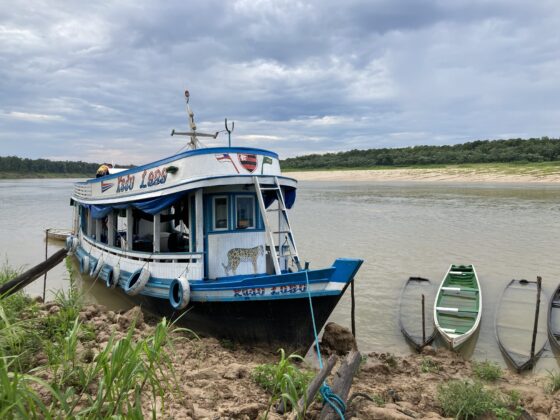
Amazon drought isolated communities is the risk at the center of a new report from researchers at the Autonomous University of Barcelona’s ICTA-UAB, working with the UN Migration Agency (IOM) and Brazilian and German partners. It maps where river communities in the Brazilian Amazon could become unable to leave their homes as water levels drop.
Amazon Drought and Isolated Communities: What the Report Finds
The bulletin, titled Drought and Immobility Risk in the Amazon Basin, is the first in a monthly series covering the coming dry season. Its focus is “involuntary immobility”: people or communities who cannot leave an area during extreme weather. In a river-based region where boats are the roads, a low river can cut off access to food, health care and markets.
The researchers flag a locality as at risk when it sits within 5 km of rivers and floodable land, more than 5 km from a road, and in an area where river levels are forecast to stay below their historical norm for a long time. The analysis draws on data from 90 river-level stations, and the authors say the method is still being refined.
Where the Risk Is Highest
Amazonas State has the most localities at risk, with areas of concern also in Acre, Rondônia and Pará. São Gabriel da Cachoeira tops the list with 343 localities, 318 of them Indigenous. Lábrea follows with 72, then Manicoré with 68, Fonte Boa with 66 and Atalaia do Norte with 64.
Brazil’s disaster monitoring center, Cemaden, reported that in September 170 of 275 monitored Indigenous units, about 62 percent, were already affected by drought.
Why El Niño Raises the Stakes
The report ties the risk to El Niño. It cites an El Niño panel that gives a 95 percent probability of a very strong event between October and December 2026, possibly among the most intense since 1950. River levels on 7 October were near or below average in the region, and November forecasts point to below-average flows across much of the North.
Why This Matters for the Shamanic Community
Many Amazonian peoples, and the healers who serve them, live along rivers. When water falls, ceremony, medicine gathering and travel between villages become harder, and so does access to emergency help. This is a reminder that the protection of Amazonian wisdom is tied to the physical survival of the communities who carry it. Our own story began with a promise to protect the rainforest and its knowledge, and that is why we follow these reports closely.
If you want to support people on the ground, see our Causes & Support directory.
Read the Full Story
Read the original release from ICTA-UAB.
Explore More From Shaman Portal
Browse our Shaman News archive, learn about Shamanic Events, or return to the Shaman Portal homepage.