











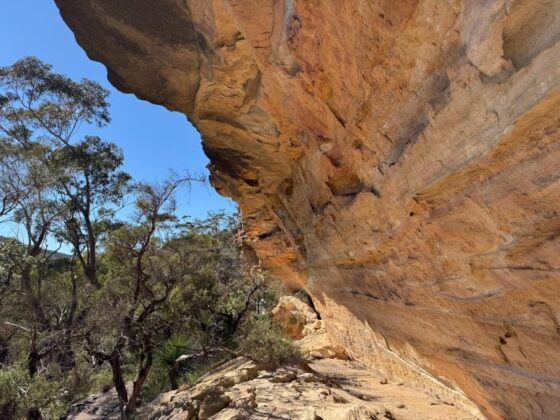
Aboriginal rock art shelters that had never been officially recorded have been located in Australia’s Blue Mountains using drones that carry laser scanners. Researchers from the University of Sydney and the Australian Museum, working side by side with Dharug custodians, report three new shelters holding red hand stencils and stone artefacts.
Aboriginal Rock Art Shelters in the Blue Mountains: What Was Found
The Blue Mountains, west of Sydney, are steep, forested and hard to walk. More than 200 rock shelters with cultural material are already recorded there, yet the university says only about a tenth of the region has been surveyed. To close that gap, a team flew a drone fitted with LiDAR, a sensor that fires laser pulses and measures their return to build a detailed 3D map of the ground beneath the trees.
Field teams then walked to the flagged spots to check them. The survey confirmed six shelters already on the state heritage register and identified three that were not. The new shelters contain stone artefacts and rock art, including red hand stencils. The researchers also noted that the drone coordinates were much closer to the real shelter locations than the coordinates in the official register.
Who Led the Work
The paper’s lead author is Dr Jacob Bongers, a digital archaeologist at the University of Sydney. Dr Amy Way, a research archaeologist working with the University and the Australian Museum, co-directs the project and led the ground checking. Wayne Brennan, a First Nations rock art expert, is the other co-director. Erin Wilkins of the Dharug Custodian Aboriginal Corporation led rock art recording at confirmed sites alongside Brennan. The results appear in the journal Remote Sensing.
The work forms part of the Gulamada Project, which describes its approach as walking side by side, combining scientific methods with First Nations knowledge. It was funded through the Australian Government’s First Nations Heritage Grants program.
Care Around Sacred Places
One detail matters for anyone who cares about sacred sites. According to the published summary, the Dharug asked that exact site coordinates and photographs of the rock art and stone tools be withheld, and the team is still checking detections with them. That choice is a reminder that finding a place and sharing its location are two separate decisions, and that custodians hold the right to make the second one.
The researchers are honest about limits too. The detection settings were tuned for Blue Mountains sandstone, the method struggles with deep undercuts, and the 19 candidates that were visited were picked by eye, so their success says little about overall accuracy. Next, the team plans to adapt the method with Aboriginal communities in western Arnhem Land and western New South Wales.
Why This Matters for the Shamanic Community
Rock shelters and hand stencils are among the oldest ways people have marked relationship with land, ancestors and spirit. For readers who follow Indigenous wisdom traditions, this story shows technology serving custodians rather than replacing them: the machines point, but the people who hold the knowledge decide what is recorded, shared and protected. It also shows how much remains unrecorded, even in a region that millions of people visit.
If you want to support Indigenous-led heritage work, you can explore our Causes & Support directory for organizations active in this field.
Read the Full Story
Read the original coverage at SciTechDaily and the university announcement at the University of Sydney.
Explore More From Shaman Portal
Browse more stories in our Shaman News archive, meet a teacher in Shaman of the Month, or return to the Shaman Portal homepage.