








Although psychedelic drugs are illegal in South Africa, many self-proclaimed healers and shamans in Cape Town openly say they use them in therapy.
Anyone convicted of their commercial use could face a fine, up to 25 years in prison, or both.
Photographer Stuart Dodds is determined to try this treatment.
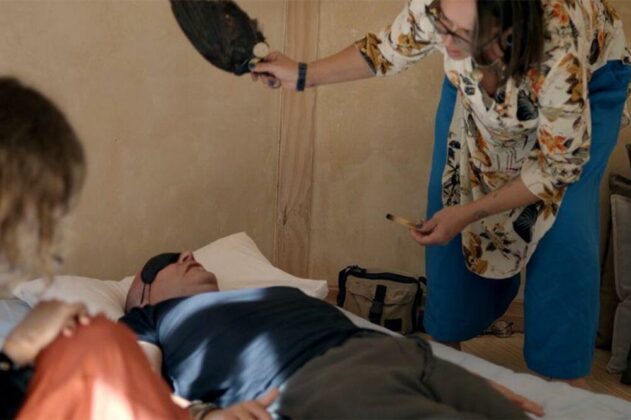
In a wooden hut nestled in the forest on the outskirts of Cape Town, he is about to undergo another psychedelic experience, believing it would help him treat his mental health problems.
He has tried medication, but is convinced that psychedelics hold the key to his recovery.
“My mom died suddenly, it was a hellish time, and then my girlfriend broke up with me a year after my mom died – that’s when I felt like someone had pulled the rug out from under me,” says the 53-year-old.
At a cost of around $2.000, the psychedelic experience he opted for involves taking doses of psilocybin (also known as magic mushrooms) and MDMA (also known as the party drug “ecstasy”).
Organizers say the price includes accommodation and a package of support services.
The effectiveness of psychedelics in treating mental health is increasingly being examined, but there are warnings against their use outside of controlled, clinical conditions.
Megan Hardy, who calls herself a “healer” and is in charge of sessions with Dodds, also takes small doses of both substances before the ritual.
She claims that this helps her “tune in to the same frequency” as the person she is treating.
“The shamanic term for it is having one foot in both worlds,” she says.
Hardy is aware that using this type of drug is illegal, but claims that its use is “righteous civil disobedience.”
Over the years, she’s experimented with drugs and “learned what works in what situations,” she says.
Greater awareness of mental health issues, combined with a rise in the number of clinical trials using psychedelics, has sparked public interest in the use of these drugs to treat conditions such as depression, anxiety, and post-traumatic stress disorder (PTSD).
One in two people in the world could develop a mental health disorder during their lifetime, according to studies from Harvard Medical School and the University of Queensland – treating it has become a multi-billion dollar business.
Before the psychedelic ceremony begins, which Stewart has agreed to have filmed by the BBC World Service, Hardy reassures the client that he can stop whenever he wants.
“If anything makes you uncomfortable or makes you feel bad, you point it out and just say, ‘Okay, we’re breaking up.'”
Her colleague Kate Ferguson also took microdoses of the drug MDMA and magic mushrooms.
None of them have formal medical education.
Dodds lies on a thin mattress on the floor of the hut covered with a gray quilt.
Wear an eye mask.
When the drugs take effect, it seems as if he alternates between states of calm and moments of twitching and spasming.
“Allow yourself to feel,” Hardy whispers, hugging him.
Two women move around the room, burning herbs and shaking shamanic rattles while chanting and wailing in a purification ritual known as “smearing.”
Hardy cools Dodds’ body with the help of bird wings, in what he claims is an attempt to purify “negative energy”.
She then offers him more MDMA.
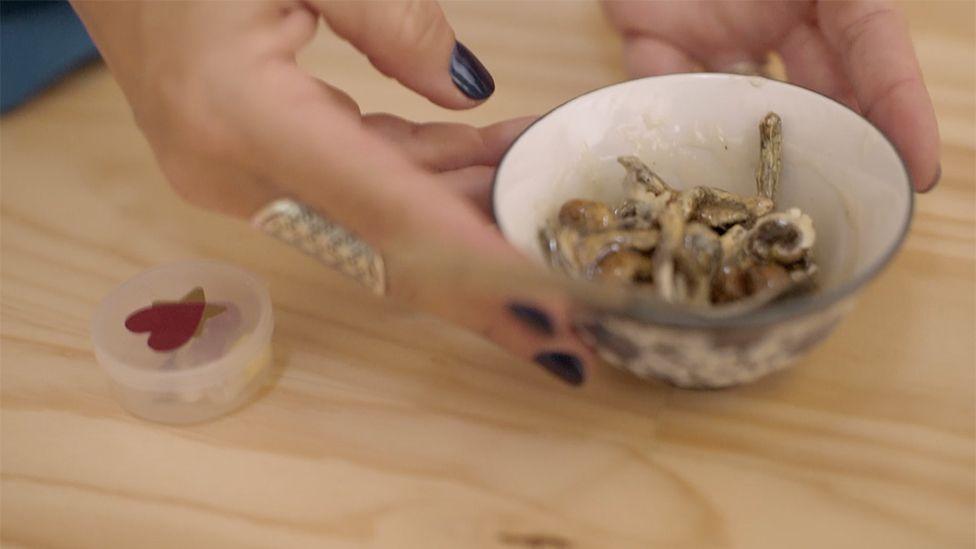
Even before the ritual began, Dodds agreed to this, but when Hardy asked him if he needed it, he shrugged and said, “I don’t know.”
“There was no extortion.”
“It was just a matter of deciding at that moment whether I wanted to take it. I had every opportunity to say, ‘Yes,’ ‘no,’ or ‘I will, I will take it,'” he says when asked by BBC reporters how he agreed to take the substances in an already altered state of consciousness.
But there are many experts in psychiatry who point out the dangers of this unregulated field.
“To give consent, you have to be in touch with reality,” says Dr. Marcel Stastny, president of the South African Psychiatric Association.
“If someone has already taken substances like psilocybin and MDMA, then they are out of touch with reality.
“In numerous trials around the world, boundary solutions are occurring,” he says.
The BBC asked Hardy if she herself was ever under the influence of drugs while working with Dodds.
“There is an assumption that a sober state of mind is preferable.”
“We work in ways that the Western mind doesn’t understand and that can seem scary,” says the self-proclaimed healer.
There is a growing body of research looking at whether psychedelic drugs could be a viable alternative treatment for conditions such as depression or anxiety and substance abuse.
One of the largest peer-reviewed studies from 2022 on the therapeutic use of psychedelics involved the use of a synthetic formula of psilocybin in 233 participants.
It showed that a 25 milligram dose taken, with psychological support from trained therapists, led to some improvements in patient-reported cases of depression.
However, a review study published in 2025 by the European Medicines Agency, which looked at a total of 595 participants in eight completed studies, recommended “more clinical evidence” before it could be approved for sale.
They also warned that taking psychedelics can trigger “increased heart rate, increased blood pressure and anxiety levels,” and that these substances must be administered in a “controlled environment.”
We’re working in ways that the Western mind doesn’t understand and can seem scary”
Psychedelic substances remain illegal throughout much of the world.
Yet, this has not curbed the growth of this industry in South Africa, as is evident from the number of services advertised online.
“I think it’s a huge problem,” says Dr. Stastny.
“He certainly exploded in Cape Town.”
“People are lost and disconnected. Everyone is looking for a pill that will solve all their problems, and there simply is no pill that will solve all their problems,” he explains.
A few years ago, Sonnet Hill, another self-proclaimed psychedelic instructor from Cape Town, gave a patient ibogaine, a powerful psychedelic extracted from a plant endemic to the tropical forests of Central and West-Central Africa.
He triggered an unexpected effect.
“He grabbed me by the neck,” Hill says.
“He wanted to kill me. Something came over him and he just wanted to kill me,” he recalls.
Ibogaine can be used as a powerful detoxification drug for people suffering from addiction.
It is illegal to purchase or use in South Africa and is only permitted under strict medical and pharmaceutical regulations.
No criminal charges were filed against Hill, and she has since refrained from giving psychedelic drugs to others.
But that didn’t change her attitude towards the area itself.
“I really, honestly think psychedelics can cure the world, I have no faith in medicine,” she says.
In another case, 26-year-old Milo Martinović traveled to South Africa to seek help for his drug addiction.
He ended up in an unregistered facility, where he was treated by a dentist and given ibogaine.
He died six hours later.
The unregistered clinic missed that he was addicted to Xanax, a benzodiazepine that should not be mixed with ibogaine.
Dentist Anvar Dživa was found guilty in 2024 on multiple counts, including aggravated murder.
This death was just one of dozens of recorded ibogaine-related deaths worldwide.
“You can’t call something a cure if it’s not one.”
“I’ve seen new patients who disassociate for long periods after taking a psilocybin trip,” says Dr. Stastny.
Evidence that psychedelics can be used as medicine may be emerging, but the online market of self-proclaimed healers is growing.
“They just know they took something, they felt great, and they want to help others.
“Those are the best of them. The worst of them have a narcissistic imagination and say, ‘I can help people, I can be better than psychiatrists,'” Stastny says.
In a forest cabin in Cape Town, the effects of Stuart Dodd’s “journey” begin to wear off.
He says he doesn’t feel “cured,” but he believes he’s on the way.
“I wanted to gain more self-awareness and understand myself better,” he says.
“I can feel it opening up all sorts of things in me, so I’ll probably go on another trip after this one,” he says.