








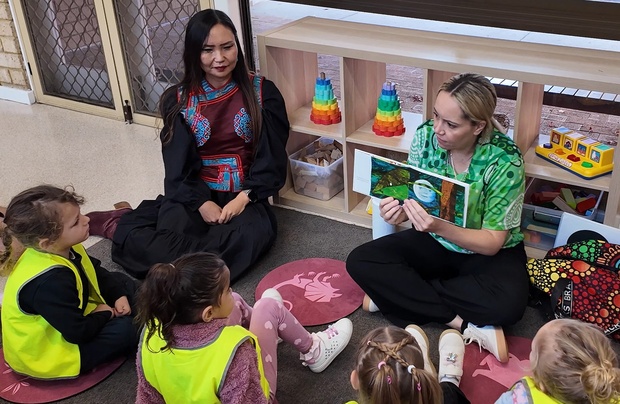
A new teaching approach called Aboriginal yarning pedagogy — more formally, “translingual yarning pedagogy” or TYP — could reshape how Aboriginal languages are taught to the next generation, at a moment when many of these languages remain at real risk of disappearing.
What Is Translingual Yarning Pedagogy?
Lead researcher Associate Professor Sender Dovchin and her team at Curtin University’s School of Education spent a year embedded in an
Aboriginal playgroup, teaching children the Noongar language through this new model. TYP combines yarning — a traditional Aboriginal practice of storytelling and shared, co-created learning — with translanguaging, an approach that encourages children to draw on every language resource available to them: English, Aboriginal languages, gesture, song, and play, rather than being restricted to one “correct” language at a time.
Why Standard Classroom Methods Fall Short
Dovchin, herself an expat Mongolian linguist specializing in second language acquisition, points out that despite being a genuinely multicultural nation, Australian classrooms often operate with a surprisingly monolingual mindset — students are typically taught to
speak standard Australian English in the “correct” way, with little room for other varieties or languages. Her research argues that
shifting away from this rigid, English-dominated model is essential for meaningfully incorporating Aboriginal languages into education.
How Yarning Circles Work in Practice
In the study, preschool-aged children took part in yarning circles, songs, and storytelling activities that let them move naturally between languages while engaging with Aboriginal cultural knowledge. Rather than separating languages or correcting “improper” usage, researchers observed children freely blending English, Noongar, and gesture together to make meaning — building not just vocabulary, but a felt connection between language, culture, and identity.
Connected to Country and the Dreaming
Yarning itself is described in the study as far more than a storytelling technique: it directly connects to Country and the Dreaming, the Aboriginal understanding of ancestral creation time that researchers describe as not a story about past events but an
By fostering reciprocal, respectful dialogue where knowledge is co-created rather than imposed, the researchers argue yarning challenges the colonial and hierarchical structure of conventional Western education.
ongoing reality.
Why This Matters Beyond the Classroom
Study co-author and Noongar language educator Tamara Tucker
emphasizes that this kind of learning builds pride, confidence, and
identity precisely because children feel the language through story,
song, and connection to Country, rather than simply memorizing it.
With most Closing the Gap targets in Australia unlikely to be met on
schedule, researchers see language revitalization as a genuine
source of hope — strengthening cultural identity, mental wellbeing,
and educational engagement for Aboriginal and Torres Strait Islander
children alike.
Why Shaman Portal’s Community Should Care
This research speaks directly to something central to shamanic and indigenous wisdom traditions everywhere: language, land, and spiritual knowledge are deeply intertwined, and losing one often means losing access to the others. A teaching model built on storytelling and lived connection to Country, rather than rigid classroom drills, is a meaningful model for cultural preservation well beyond Australia’s borders.
Explore More From Shaman Portal
Catch up on this month’s Selection Shaman of the Month, Selection Book of the Month, Selection Film of the Month, or browse more Shamanic News.