









Where Wisdom Becomes Who We Are
Spiritual growth is not measured by what we know, but by how we meet the experiences that ask us to live what we believe.
By Laurie Wondra
If spiritual awakening opens the door and spiritual maturity is cultivated through experience, then life itself becomes our classroom. Every relationship, disappointment, success, loss, change, and unexpected event offers an opportunity to practice what we believe. Spiritual ideas may inspire us, but it is through our everyday choices that those ideas become embodied wisdom.
One of the greatest misunderstandings about the spiritual path is the belief that life should become easier as we become more spiritually aware. We may imagine that awakening will protect us from conflict, difficult people, disappointment, or experiences that shake us to our core. We may believe that if we meditate, pray, remain positive, and live with good intentions, fewer painful things should happen.
Yet spiritual growth does not remove us from the human experience. Life continues to present challenges, but the way we meet them can begin to change.
I prefer to think of these experiences as opportunities rather than tests or punishments. The Universe is not keeping score, and life is not trying to determine whether we are worthy of love, healing, or enlightenment. Instead, our experiences reveal where growth is still unfolding.
Every challenge becomes a mirror. Every disappointment becomes an invitation to look more deeply. Each unexpected turn quietly asks: Who are you becoming through this experience?
That question takes us beyond simply asking, “What happened to me?” What happens is only one part of the story. The deeper transformation is found in how we respond, what we learn, what we release, and who we choose to become because of it.
Life Reveals What Is Within Us
Imagine placing a teabag into hot water. The water does not create the tea; it reveals what was already held within the bag. The heat draws out its color, fragrance, and flavor. Life works in much the same way.
Pressure reveals our patterns. Conflict reveals our beliefs and insecurities. Loss reveals our attachments and what we value most deeply. Success reveals our character and how we use influence or abundance. Difficulty exposes the places within us that may still need healing, compassion, or greater understanding.
This is not something we need to fear. If life never challenged us, we might never recognize the beliefs that limit us or discover strengths we did not know we possessed.
When something difficult occurs, we can gently ask, What is this revealing to me? We do not ask to blame ourselves or suggest that we created every painful experience. We ask because awareness is the beginning of freedom. Once we see a pattern clearly, we are no longer required to repeat it unconsciously.
When Criticism Touches an Old Wound
Very few people enjoy being criticized. Whether it comes from a family member, friend, coworker, stranger online, or someone we respect, criticism can awaken old feelings of inadequacy, rejection, embarrassment, or not being understood.
Our first impulse may be to defend ourselves, explain our intentions, withdraw, or spend days replaying the conversation. Spiritual maturity invites us to pause before reacting. Instead of immediately deciding that the other person is wrong—or that we are—we become curious. Is there anything useful within their words?
Sometimes the answer is no. Not every criticism is fair, accurate, or well-intended. We are not required to accept every opinion someone has about us.
At other times, even poorly delivered criticism contains a seed of truth. Maturity allows us to separate the message from the delivery. We can consider another perspective without surrendering our judgment or self-worth, and we can acknowledge something valuable without accepting disrespectful treatment.
The most helpful question may be: What, if anything, belongs to me? If nothing does, we can release the criticism without carrying resentment. If something does, we can take responsibility, make a change, and grow. Either way, we do not have to abandon our peace.
When Rejection Becomes Redirection
Rejection is one of the most painful human experiences. A relationship ends, a job opportunity disappears, a friendship changes, or someone we care about chooses another direction. It is easy to interpret the experience as proof that we were not good enough, lovable enough, talented enough, or worthy enough.
Spiritual maturity allows us to consider another possibility: not every closed door is a judgment of our worth. Sometimes rejection is redirection. An opportunity may not align with the path ahead. A relationship may have completed what it came to teach us. The timing, circumstances, or readiness may not be right.
Imagine trying to force a flower to bloom in winter. No amount of effort can change the season. The flower is not a failure, nor is the winter wrong. Timing matters. Alignment matters. Readiness matters.
Many of us can look back and identify experiences that once felt devastating but eventually became turning points. The end of a relationship can create space for healthier love. A lost opportunity may redirect us toward a truer calling. A disappointment can change the course of our lives in a way we could not have anticipated.
We do not have to pretend an ending is painless or immediately search for a positive meaning. We can grieve what did not happen while remaining open to what may now become possible. Some endings are sacred beginnings wearing unfamiliar clothing.
When Relationships Change
One of the quieter challenges of growth occurs when relationships change. As we evolve, not everyone in our lives will grow in the same direction or at the same pace. Some friendships deepen, others gently fade, and some come to an end.
This can be heartbreaking, especially when we share years of memories with someone. We may try to hold on to what the relationship once was or assume that someone must be at fault.
Mature love understands that people enter our lives for different reasons and remain for different lengths of time. Some teach us, some support us, and some challenge us to grow. Some walk beside us for decades; others accompany us for a single season. Not every changing relationship requires blame. Sometimes harmful behavior or betrayal must be acknowledged. At other times, growth has changed the landscape. Two people can care for one another while recognizing that their lives are moving in different directions. We can bless what was, honor what is, and remain open to the relationships still waiting to enter our lives.
When Plans Fall Apart
Plans help us feel secure. We organize, prepare, and imagine how life should unfold—and then circumstances change. A business shifts. A flight is canceled. A relationship ends. A health concern alters our priorities. A dream takes an unexpected turn.
We may interpret disruption as failure or assume that we have lost our way. Yet many meaningful chapters begin when the original plan is interrupted.
Remaining open to a larger possibility does not mean assigning a magical explanation to every disappointment or denying practical reality. It means staying flexible enough to discover what else may be possible.
Trees that refuse to bend can break in strong winds, while those that move with the wind are more likely to survive. Spiritual maturity develops that same flexibility within us. This is not passivity or resignation. It is resilience: the willingness to adapt without abandoning ourselves, our values, or the deeper purpose guiding our lives.
When Health Changes
Few experiences challenge us more deeply than changes in our health. Illness can slow us down, alter our priorities, and reshape our relationship with time, our bodies, our independence, and the future we once imagined.
For many people, including me, health becomes one of life’s greatest teachers. It asks us to listen to our bodies with greater respect and compassion. It teaches us that strength is not always demonstrated by pushing harder, remaining productive, or pretending we are unaffected. Sometimes strength is found in resting, receiving help, changing direction, or allowing ourselves to be cared for.
Illness is not evidence that someone has failed spiritually, and healing is not proof of spiritual superiority. Claims that people are sick because they did not think positively enough can cause profound harm. The body is complex, life is complex, and many factors contribute to health and illness.
Health challenges can, however, awaken qualities that might otherwise remain undeveloped. They can deepen compassion, patience, humility, gratitude, and presence. We may discover that our value was never based on how much we accomplished. We may learn to receive as graciously as we once gave and become more understanding of the invisible struggles others carry.
When Loss Changes Everything
Loss comes in many forms. We grieve the death of people and animals we love, but we may also grieve an identity, a dream, a relationship, a home, a career, our youth, our health, or a familiar way of life. Even positive change can carry grief because every new beginning asks us to leave something behind.
Grief is not something we overcome. It is something we gradually learn to carry with tenderness and grace. Love leaves fingerprints on our lives, and when someone or something meaningful has touched us deeply, its absence naturally leaves an ache. That ache is not weakness. It is evidence that we loved, hoped, dreamed, or cared. Spiritual maturity does not require us to avoid grief, rush through it, or use spiritual ideas to bypass pain. It allows grief to become another expression of love.
Over time, grief may become quieter and more spacious. It may return unexpectedly through a song, a scent, an anniversary, or a familiar place. The sadness may remain, but it begins to live alongside gratitude. The love does not disappear; only its form changes.
The Sacred Space Between Reaction and Response
One of the clearest expressions of spiritual maturity is learning to respond rather than react. Reaction comes from habit, fear, anger, or self-protection. Response creates enough space for awareness and intention to enter.
When someone speaks harshly to us, our first impulse may be to strike back, defend ourselves, shut down, or walk away. A conscious response begins with a pause. We breathe. We notice what is happening within us. Then we choose how we want to proceed.
That pause may last only a few seconds, yet it can change everything. It allows us to speak honestly without becoming cruel, protect ourselves without hardening our hearts, and maintain compassion without tolerating harmful behavior.
We will not always get this right. Spiritual maturity is not the absence of mistakes. It is the willingness to recognize them, take responsibility, repair what we can, and choose differently next time.
Becoming More Fully Human
We often imagine spiritual growth as climbing a mountain—moving higher, becoming brighter, and drawing closer to enlightenment. That image can cause us to judge ourselves when life feels difficult or an old wound resurfaces.
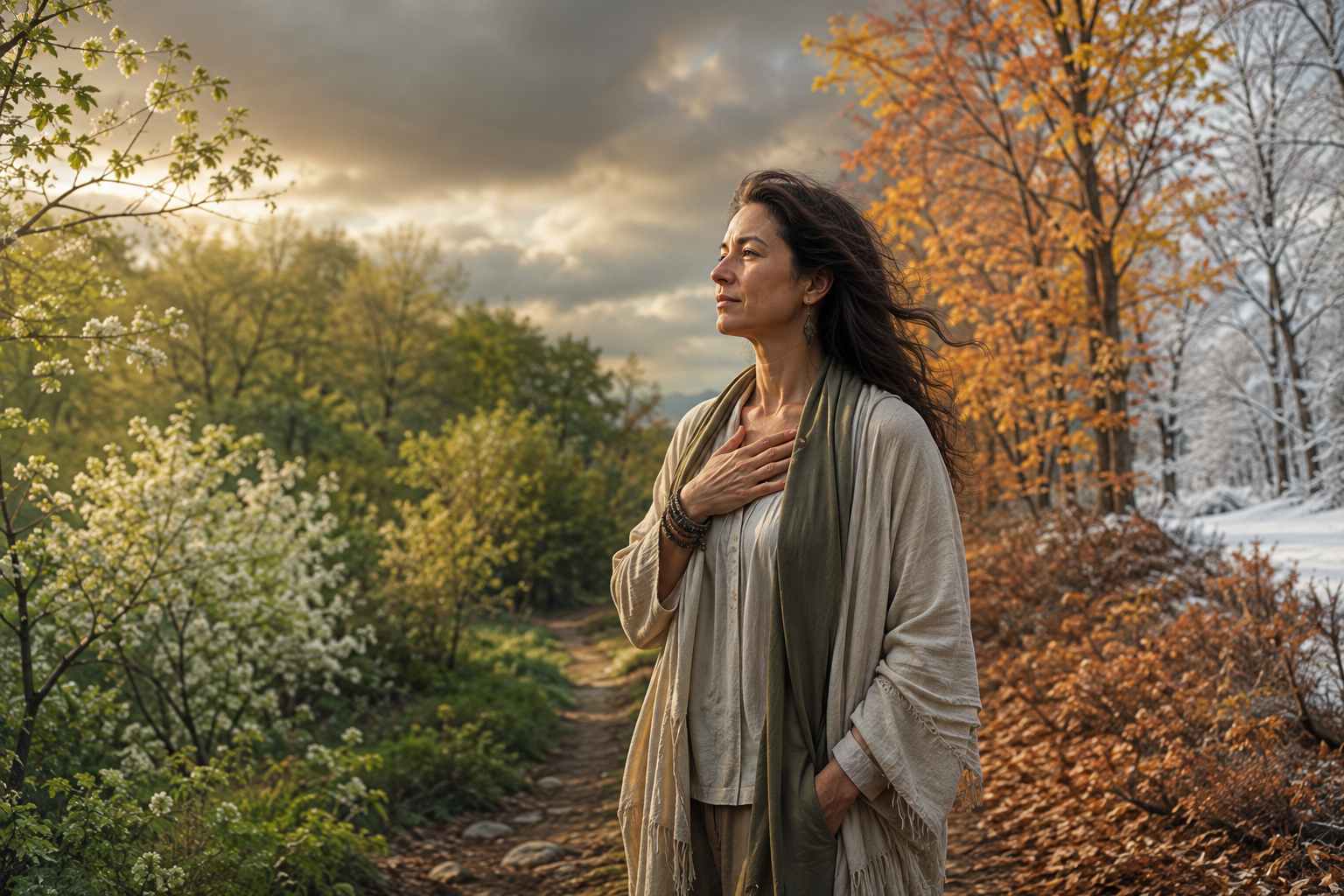
Growth looks less like climbing and more like moving through the seasons. Spring teaches renewal. Summer teaches expansion and expression. Autumn teaches release and gratitude. Winter teaches rest, patience, and trust. None of the seasons is a mistake, and none lasts forever.
In the same way, every season of life contributes to who we are becoming. Joyful seasons teach gratitude. Difficult seasons teach resilience. Uncertain seasons deepen faith. Quiet seasons teach presence. Loss reveals the depth of love, and renewal reminds us that life continues to unfold.
Perhaps spiritual maturity is not about becoming more enlightened, but more authentic—less concerned with appearing awakened and more committed to living with integrity. It asks for less performance, proving, and perfection, and more presence, compassion, courage, responsibility, honesty, humility, and grace.
The wisest people I have known rarely spoke about how evolved they were. They did not need to convince anyone because they embodied their beliefs. In their presence, others felt calmer, accepted, and safe enough to be themselves. They listened more than they spoke. They remained curious, admitted what they did not know, and carried confidence without arrogance. Their lives became their teaching.
Genuine spiritual growth is not an escape from our humanity but an expression of the best of it. It is choosing kindness when anger would be easier, truth when pretending would be more comfortable, and compassion while maintaining healthy boundaries. It is choosing humility over the need to be certain, hope without denying reality, and love not only as a feeling but as a daily practice.
Perhaps the soul never asked us to be perfect. Perhaps it simply asked us to become more deeply, beautifully, and authentically ourselves.