











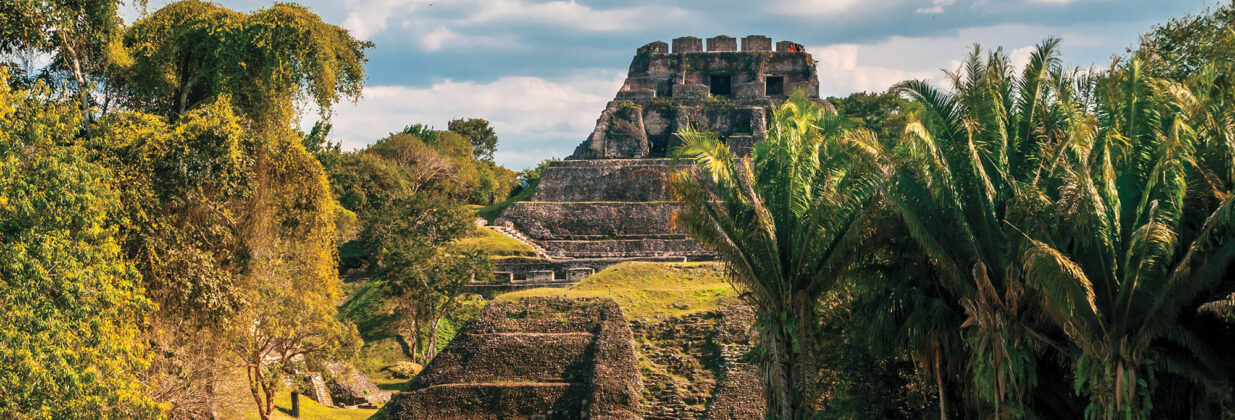
A striking pair of discoveries at Xunantunich, a Maya city in Belize, is giving archaeologists new insight into both shamanic ritual life and how the ancient Maya educated their children — a burial believed to belong to a shaman, found just steps from what researchers think was an art school for elite Maya boys.
An Ancient School for the Maya Elite
On a ridge above the Mopan River, archaeologists led by Kathryn Brown of the University of Texas at San Antonio uncovered a complex they believe housed students during the late seventh and eighth centuries AD. The site includes a large sweat bath, gaming boards, and rooms fitted with benches for sitting or sleeping — evidence, researchers suggest, that schooling for wealthy Maya boys came with real comforts and diversions alongside rigorous instruction.
Nearly 400 Practice Drawings Found in the Pyramid
Inside El Castillo, the city’s monumental central pyramid, two rooms contain around 400 individual drawings on the walls — sketches of a
headdress-wearing sage, calendar dates, hieroglyphs, and repeated attempts at drawing monkeys, apparently made by learners of varying
skill levels. Brown’s team interprets the space as a dedicated training room for young scribes and artists, offering rare direct evidence of how artistic and ceremonial knowledge was passed down to the next generation.
The Shaman’s Burial and Its Sacred Symbolism
Just east of the school, in a separate shrine, archaeologists uncovered a skeleton believed to belong to a shaman, buried alongside two carved shell disks thought to have served as ear ornaments or parts of a ceremonial headdress. Both disks depict a human figure with a deer’s head holding one of its own eyeballs in its hand, the optic nerve still visibly attached, while the figure’s other eye gazes toward a separate carved figure representing the Vision Serpent — a being understood in Maya cosmology as a conduit between the human and divine realms. Researchers interpret the imagery as depicting a moment of ritual transformation, in which the shaman becomes their own spiritual guide while communicating with the otherworld.
Tools of Ritual Practice
Alongside the burial, archaeologists recovered flaked chert artifacts likely used in ceremonial practice, including pieces shaped like centipedes and scorpions and others that may represent broader cosmological symbols. Tools like these are understood to have served ritual functions such as bloodletting during ceremonies — a practice with deep roots across Mesoamerican spiritual tradition.
Two Decades of Discovery at Xunantunich
This shaman’s burial and the nearby art school are only the latest finds at a site archaeologists have been excavating for more than twenty years. Since 2008, Brown’s team has also uncovered a large ceremonial platform dating to the eighth century BC, deliberately positioned so residents could track the sunrise, sunset, and stars to plan agricultural cycles — a use of the sky that required clearing a substantial section of surrounding rainforest.
Why This Matters for Understanding Maya Shamanic Tradition
Researchers stress that the knowledge embedded in these discoveries — from ritual practice to artistic training — had to be deliberately taught from one generation to the next, a continuity that connects the ancient Maya directly to shamanic and ceremonial practitioners working within related traditions today.
Explore More From Shaman Portal
Catch up on this month’s Selection Shaman of the Month, Selection Book of the Month, Selection Film of the Month, or browse more Shamanic News.