










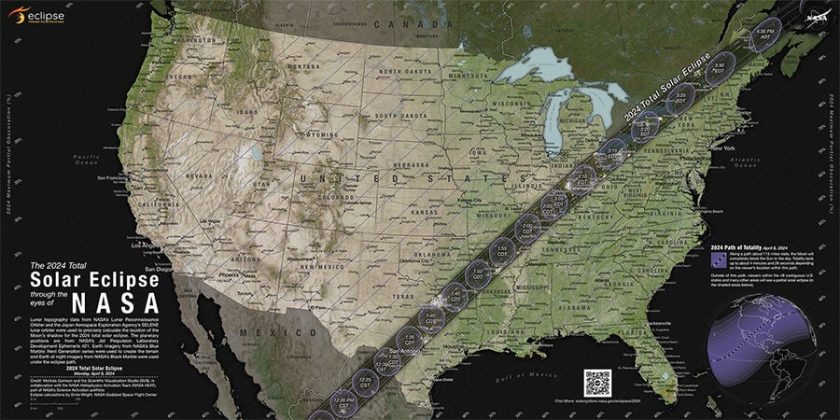

TAHLEQUAH – On April 8, North America will experience a total solar eclipse, the second in seven years. While science explains solar or lunar eclipses, many tribes have their own stories or beliefs about them.
A total solar eclipse is when the moon will be positioned between the earth and the sun, completely blocking sunlight and casting a shadow on the earth, turning it dark for a few moments, depending where on the earth the shadow is being cast.
While the moon is 400 times smaller than the sun, it is also 400 times closer to the earth than the sun, making the moon and the sun appear the same size in the sky thus creating the total eclipse.
Cherokee people have lore about a giant frog eating the sun or the moon during an eclipse.
The story goes that before it was known as an eclipse, Cherokee people would see the sun or moon slowly disappear from the sky and as it would dim, it was believed a giant frog, or walosi, was eating the sun or the moon. To bring it back, the Cherokee people would make a lot of noise to scare the frog away and restore balance.
“Cherokees would go outside and make a lot of noise by doing things like banging rocks together, shaking shells and shouting to scare the frog away,” Cherokee Nation citizen Roy Boney said. “When Cherokees got guns and firecrackers, those were added to the mix.”
Sequoyah National Research Center assistant director and archivist Erin Fehr, through research, has learned about what the eclipse means to different tribes.
The Kumeyaay tribe in southern California has lore that the sun and moon were once lovers but were not able to marry because it would throw life off balance, so to stay separate, the sun stayed awake during the day and the moon stayed awake at night.
“When the eclipse happens, they have stolen time together and then they break apart after just a few minutes,” Fehr said.
Fehr said that when it comes to the Navajo tribe, their belief is that an eclipse signals a time for reflection and meditation, to stay inside, not to eat or drink and sit quietly in reverence.
“They believe that because it’s such a sacred time between the sun and moon, that you should not witness it,” Fehr said.
Fehr said there are also recorded significant historical events that have happened during a total solar eclipse, such as the emergence of the Haudenosaunee Confederacy on August 22, 1142.
Haudenosaunee Confederacy was originally made up of the Mohawk, Oneida, Onondaga, Cayuga and Seneca Nations in the northeast United States.
While science had yet explained eclipses, many tribes and groups had their beliefs about what was happening as they experienced the solar and lunar eclipses.
“I think that definitely shows the importance of the sun and why people made up stories to explain eclipses because they don’t happen that often,” Fehr said.