










The first time I saw Kim Kumhwa (김금화) was unknowingly and on a screen. It was in Ulrike Ottinger’s documentary movie The Korean Wedding Chest (“Die koreanische Hochzeitstruhe”, 2009, a co-operation with the International Women’s Film Festival in Seoul), back in Berlin. The film shows the rituals preceding a traditional Korean wedding, a narrative that is framed by a fable about a ginseng woman and a ginseng man that includes a ritual.
As I found out today, when doing some background research, Kim Kunghwa is listed among the cast: SCHAMANIN – Kim KeumHwa
[“Schamanin” is German and means “female shaman” or “shamaness”; “KeumHwa” is just an alternative spelling of “Kumhwa” – using the current system of romanization, it would be “Geumhwa”.]
So Kim Kumhwa was playing a shamaness. You can see her perform early on in the trailer. I think it’s clear to anyone that she is not playing a shaman(ess) – she is the shaman. She is a mansin (만신). Or, she was.
Today is the day that Kim Kunghwa passed away.
May She Rest in Peace.

I didn’t see (yet) the movie Manshin: Ten Thousand Spirits by Park Chan-kyong (박찬경, 만신, 2013. trailer, review by Jungmin Sog) that restages key scenes from Kim Kumhwa’s life and casts herself in the main role. I have to do a lot of reading to get to know more about her, what appears to be a fascinating life, too.
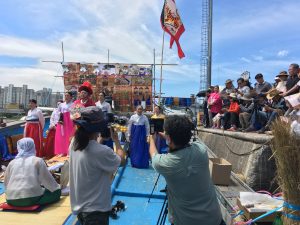
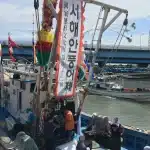
But I saw her live, not too long ago, in July 2018, at Sorae-pogu, a small harbor in the Southern part of Incheon (소래포구, 인천 남동구). I had heard that she would hold her yearly “West Coast Fishing Ritual” soon and we got up early, friends and family, to go to the sea. I had always wanted to see her sometime, now was the chance!
[The full name of National Intangible Cultural Asset No. 82-2 is Seohaean Baeyeonsingut and Daedonggut, abbreviated as “Fishing Ritual of the West Coast” (국가무형문화재 제82-2호: 서해안배연신굿 및 대동굿 / 西海岸배연신굿 및 大同굿), see the Cultural Heritage Administration’s homepage for images and details in English and Korean. The ritual we attended was a “public event” (공개행사) that takes place once a year, as far as I know.]
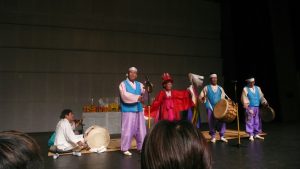
I remembered that I had actually see her perform the opening ritual for a conference on theatre “after post avant-garde” at K-Arts (한국예술종합학교) in 2012. It was quite memorable, in particular when the scholars lined up to offer money on stage, becoming part of the ritual that was dedicated to their scholarship. Not theatre in the strict sense, but certainly more avant-garde than much that happens on curtained stages.
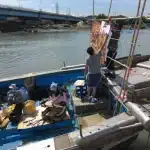
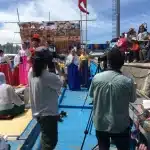
Back to last summer: When we arrived at Sorae-pogu, people were already preparing the boat for the ritual. Kim Kumhwa had arrived, too, but was waiting in the car on the side. She was slender and maybe a bit feeble, but given that the was almost 90 years old, she appeared vital. She was helped onto the boat and took a seat next to the center, where she stayed for most of the ritual. The ritual began, various people performed at the bow of the boat, including Kim Kumhwa. Lunch was offered and then we took off. The boat drove several circles while onboard things got wild, with music intensifying, people dancing together.
These are some images I took on that day (click to enlarge):
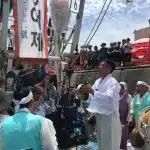
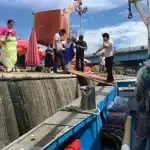
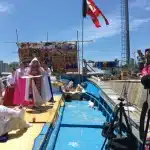
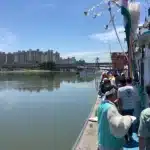
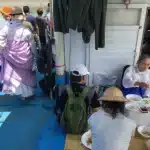
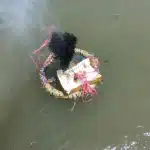

I believe in rituals. That is, I believe in their performative power, not so much their metaphysical meaning. While I don’t know much about the inner workings of the musok-scene nor have I attended many rituals, the power of ritual to make people – members of the community as well as outsiders like me – move, immerse, commune became very clear on that day.
고인의 명복을 빕니다.
— 23 Feb. 2019 (土)