










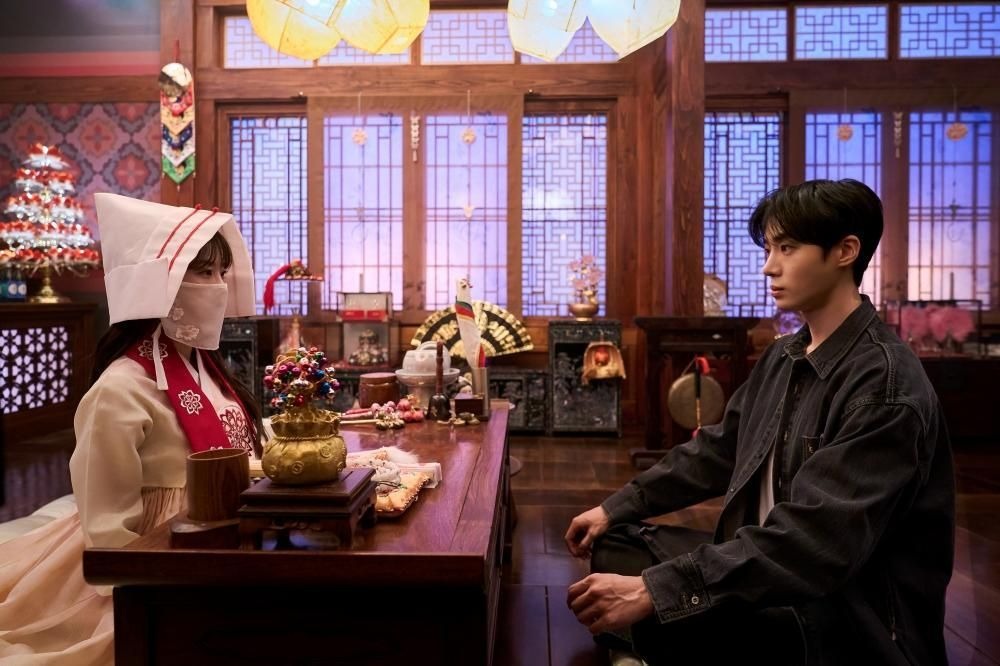
In the tvN fantasy romance drama “Head Over Heels,” high school student Seong-ah, who secretly works as a shaman by night, says, “When life wavers in the face of crisis, people seek out shamans.”
She performs a ritual called “cheondoje” to send off spirits and holds exorcisms to drive away evil ghosts, but the overall tone of the drama is not entirely dark and gloomy.
During the solemn ritual, her watch alarm goes off, prompting her to hurry the ceremony, saying, “If I can’t finish the ritual in 10 minutes, I have to go.” As a ghost protests, she says, “Today is the midterm exam. You know what it means for a high schooler to mess up their grades, right?”
The drama, which premiered on June 23, depicts the relationship between Seong-ah (Cho Yi-hyun), a teenage shaman who can see ghosts, and Gyeon-woo (Choo Young-woo), a transfer student destined for an early death. Seong-ah strives to save Gyeon-woo, her first love, from his fate. The drama convincingly portrays the tensions between rituals and exams, shamanism and high school life, blending them naturally into a compelling coming-of-age story.
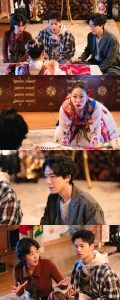
From symbol of fear to central element in dramas
There was a time when portrayals of shamanism on TV were meant to evoke fear. It typically used it as part of a setting in remote rural areas or as the backdrop for strange ghost stories. Even in KBS’ “Korean Ghost Stories” (1977–89), a representative horror series of its time, shamans were often supporting characters or portrayed as villains.
However, in the 2020s, K-dramas started to reinterpret shamanism in new ways. Instead of old shrines, the setting is now urban classrooms and instead of middle-aged women, it is schoolgirls in uniforms who confront spirits. As a result, shamanism has shifted from being a symbol of fear to a central element of popular contents, moving from the fringes of genre to the very center of mainstream success.
The recently concluded MBC drama “Oh My Ghost Clients” is a unique example of combining shamanism with real-world issues. It tells the story of Noh Moo-jin (Jung Kyung-ho), who receives a command from a supernatural being to “resolve the grudges of workers.” Suddenly able to see ghosts, he gradually becomes a mediator between the living and the dead, much like a shaman.
In this context, shamanism serves as a symbolic device. Listening to the stories of workers who died unjustly and soothing their lingering resentments and seeking social truth can be seen as a modern version of the traditional cheondoje ritual, replacing exorcism ceremonies. Ultimately, shamanism functions as a tool for listening and comforting, revealing the structural oppression present in the realities of labor.
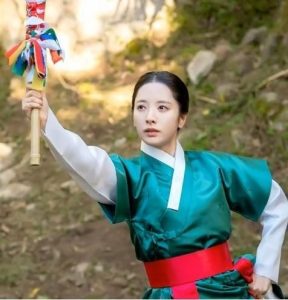
SBS drama “The Haunted Palace” also presented shamanic narratives in a historical setting. Yeo-ri (Kim Ji-yeon), who initially rejects her fate as a shaman, ultimately embarks on a journey to break the curse of a vengeful spirit holding a grudge against the royal family, together with Kang Cheol (Yook Sung-jae), a mythical serpent inhabiting the body of her first love. Centered on romance, the story fuses exorcism with fantasy and palace intrigue.
Korean shamanism and occult themes are being blended with diverse genres and reflect changing social attitudes. This evolution has made shamanic figures more relatable and emotionally resonant, securing their place in the heart of K-content.
Experts say these changes reflect a social atmosphere in which superstition and mythology have emerged as major interests for the MZ generation, a term combining Millennials and Gen Zers, and public attention toward shamanism has grown amid widespread uncertainty in today’s world.
In a society where upward mobility is blocked and the future is unclear, shamanism serves not as a spell to change fate, but as a channel for expressing unspoken feelings. Shamans in dramas are depicted less as mysterious or occult figures and more as emotional mediators who interpret real-life pain.
“Unlike Western ghosts, who often harm the living for no reason, traditional Korean ghosts are beings with regrets who seek communication with the living. That’s why shamanic rituals in Korea are about soothing and sending off spirits, rather than exorcising them as in the West,” said culture critic Jung Duk-hyun.
Citing “Possessed Love,” a dating reality show featuring younger fortune-tellers, Jung also said that with young shamans appearing on entertainment programs, public perception of them has become more positive.
“The comfort and healing they provide seem to offer a kind of fantasy for modern people. Whereas shamanism used to be confined to the horror genre, it is now combined with emotional dramas, fantasy and youth stories, achieving both popularity and relatability.”
Another culture critic, Ha Jae-keun, also echoes this view.
“Korean shamanism is not simply about repelling evil spirits, but about comforting and sending off those who died unjustly. Ultimately, it can be expanded into stories that rescue wounded beings and soothe hearts, making it an ideal device for emotional narratives,” he said.