









“We live in a provocative, evolving time that promises to impact how we live together on the planet, how we continue as a species, and how we understand ourselves in relation to a larger universe…this is the time to fully express who we are.”
—Llyn Roberts

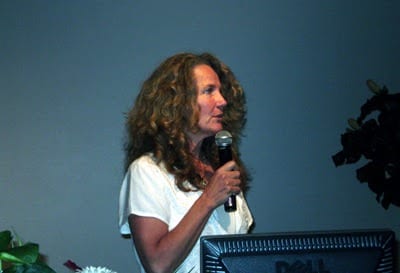
Llyn Roberts at the 2012 Tipping Point Prophets Conference, Vancouver
Shapeshifting into Higher Consciousness
by Llyn Roberts
O-Books, John Hunt Publishing Ltd. 2011
Book Excerpt | Chapter 7 – Shapeshifting with the Deep Feminine
Cultivate Awareness
Of many ways to perceive that are resonant with what we term the Deep Feminine, John and I learned the following strategy from a Maya teacher when leading a group with the Prophet’s Conference in December 2010. The slender, young man who was our guide exuded a gentle air and when he spoke his eyes smiled. In his characteristically affable manner Mario asked us to walk for fifteen minutes amidst the ancient ruins focusing on the “modern” aspects of our surroundings: the people, the directional signs, the gates and reconstructed pathways, the sounds of airplanes and other noises such as humans talking, the clothing and watches visitors wore, etc. Then, for the next fifteen minutes we were to stroll while concentrating on the antiquated and natural aspects of the site: the pyramids, the sight and sound of the howler monkeys, the eyes of people, the trees and sky, the mounds of land indicating hidden structures, and so on. The effect was powerful. The concealed world came alive. A dual perception was achieved which firmly rooted us in the present yet, which, sharpened our acuity of the normally undetectable.
The practice our insightful friend, Mario, employed to open seekers to subtle energies at ancient Maya sites can be applied anywhere, even in cities. As challenging as it may seem, anyone can develop simultaneous perception and urban areas offer an ideal environment for this practice. On your own walk, begin by noting what is contemporary: the people and their clothing, the objects such as cars and street lights and buildings, the mechanical sounds, etc. Then, on the next fifteen minutes of your stroll shift your attention to the timeless, the antiquated and the natural. Note the plants and sky, the eyes and emotional quality you sense of those who pass you by, watch the birds and the squirrels in the trees and listen to their sounds, observe the old buildings amidst the modern cityscape, etc. Focus on what propels you back through time and connects you with richer details of the human and natural world while, for a time, ignoring contemporary or surface traits. Even when with a group or inside a building, you can note the obvious then shift attention to the subtle. In doing so, you will pick up on feelings, energies and nuances routinely filtered from awareness.
This orientation sharpens intuition and grounds us to consciously interact with the world. We open to the spaces in between objects, things, thoughts and habit to the many worlds that coexist with our own. In touching the expanded field of energy that comprises our reality, shamans can detect the “energy history” of locations, the emotional tone of persons or animals passed on, or of the lands and waters, as well as engage the spirits of locations, non-visible helpers and the elements. Each place, item, person and environment has an energy we can tap into. Imperceptible from common view, these are readily discerned through shamanic tracking, as in the exercise above.
Attuning to the subtleties makes us receptive so we can participate more fully with life and also understand how the invisible impacts us and our societies. Many life forms exist beyond our own and every action, emotion, and thought leaves an energetic imprint that we can pick up on and may also be affected by. For these reasons, shamanic peoples enact rituals to impact the energy of those passed on, of land, objects, and turbulent or otherwise significant events. Through spiritual means they may be guided to draw upon for guidance, enhance the well being of, or even exorcise, unseen influences.
Highlighting the relevance of the non-visible is a story of a group who visited a shrine containing their teacher‘s relics. The small group of followers walked directly to the sanctified building soon after arriving at the isolated retreat center, at which time one person with no history of epilepsy had a seizure. Though stunned, the person recovered with no recurrence and the seizure was considered a fluke. In later visiting this retreat center myself, I was struck by the shrine’s spiritual interaction with the surrounding mountain peaks which created a commanding vortex of energy. That the small entourage walked straight to the relic building, meant the group was obviously unaware of this. Otherwise they would have connected first with the land and honored the larger circle of relationships, which would also have helped them acclimate to its energy. I cannot say whether or not this person’s seizure was induced by these intensified energies. But it is always wise to enter sacred sites respectfully and with awareness of the larger circle of beings who reside there.
Holding deeper attention is all it takes to illumine what is invisible. Then we must properly greet these presences in order to understand how to relate to them. The exercise above and those in Chapter Four offer great ways to do this. Second nature to indigenous people, even those who are spiritually oriented can miss the subtleties. Yet, in doing so, we tap only a fraction of what is happening not only at sites of power, but in daily life.

Llyn Roberts and John Perkins – Shapeshifting in the Lands of the Maya 2009
Visit John Perkin’s website: https://johnperkins.org/
ABOUT LLYN ROBERTS
Award-winning author, Llyn Roberts is a prominent teacher of healing and shamanism. Her books include Shamanic Reiki, The Good Remembering, and the Independent Publisher’s award-winning Shapeshifting into Higher Consciousness. Her most recent book, Speaking with Nature, coauthored with Sandra Ingerman, is a Nautilus Gold award-winner.
Purchase Shapeshifting Into Higher Consciousness here
Visit Llyn Roberts’ websites:
www.shamanicreikiworldwide.com