












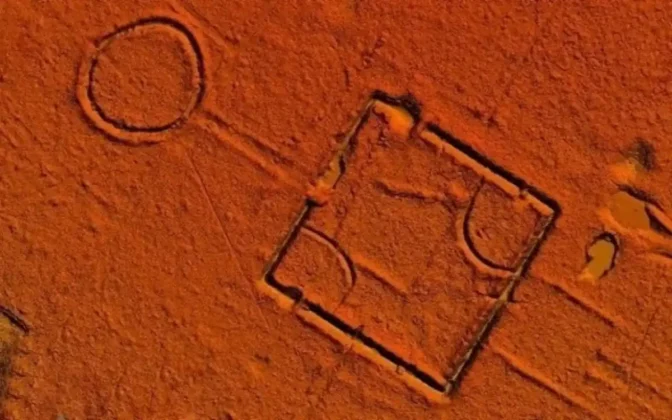
A newly documented ancient society, now named the Aquiry civilization, once shaped a vast stretch of the Amazon rainforest for nearly 1,500 years — housing millions of people before vanishing in a collapse that coincided with the fall of the Classic Maya civilization.
How the Aquiry Civilization Was Discovered
An international research team, led by Martti Pärssinen, professor of Indigenous studies at the University of Helsinki, used airborne laser scanning technology (LiDAR) to survey roughly 4,500 square kilometers of southwestern Amazonia. What they found rewrites the
long-held assumption that the Amazon was largely untouched wilderness before European contact: more than 400 well-preserved sites featuring monumental ceremonial architecture, hidden for centuries beneath dense rainforest canopy.
A Civilization the Size of Syria
The Aquiry civilization’s territory spanned approximately 183,000 square kilometers — comparable in size to modern Syria — and was home to an estimated 1.25 to 3 million people at its peak, according to comprehensive surveys and radiocarbon dating. Extrapolating from
the surveyed area, researchers arrived at a cautious estimate of more than 20,000 ancient earthwork ceremonial centers across the civilization’s full territory, with the largest known site covering 50 hectares. The name Aquiry comes from the Indigenous term for the Acre River, which runs through the region.
Not One Kingdom, But Many Communities
Researchers are careful to note the Aquiry wasn’t a single unified realm, but rather a network of many different, multicultural communities spread across the region. Much about these societies remains unknown — including what languages they spoke or what name they called themselves. What is clear is that they built and maintained large political and ritual centers over a span of more than a millennium.
A Collapse That Mirrors the Maya
Perhaps the most intriguing part of the discovery is its ending. The Aquiry civilization appears to have undergone a relatively rapid collapse around 850 CE — a timeline that closely coincides with the abrupt collapse of the Classic Maya civilization in Mesoamerica, and with the decline of the Tiwanaku and Wari cultures in the Andes. Researchers haven’t determined a definitive cause, but the temporal overlap raises real questions about whether a shared continental-scale climatic or social factor affected multiple civilizations across the Americas during that period.
Why This Matters for Understanding Indigenous Amazonian Wisdom
For Shaman Portal’s community, this discovery is a reminder that the Amazon’s Indigenous history runs far deeper and more complex than most Western accounts have acknowledged. Long before European contact, southwestern Amazonia sustained sophisticated societies with planned ceremonial landscapes and large-scale environmental management — a legacy that echoes into the region’s living shamanic and ceremonial traditions today. Researchers also note that ancient human influence on the region’s carbon balance should now factor into future climate models, underscoring how much these historic societies actively shaped the land, rather than simply inhabiting untouched wilderness.
Explore More From Shaman Portal
Catch up on this month’s
Selection Shaman of the Month, Selection Book of the Month, Selection Film of the Month,
or browse more Shamanic News.