








Archaeologists have discovered more about one of Central Europe’s most astonishing prehistoric burials: a 9,000-year-old grave belonging to a Mesolithic woman from Bad Dürrenberg in Germany, who had long been thought to be a shaman. The grave was first exposed in 1934 during emergency construction work. Renewed excavations beginning in 2019 finally allowed specialists to carry out more modern research on the grave, and the results are transforming what researchers know about this enigmatic figure.
The burial contained the remains of a woman who would have been in her thirties or forties at the time of death, laid to rest with an infant who would have been about six months old. Artifacts recovered in 1934, including an antler headdress and animal-tooth pendants, suggested her ceremonial status. However, researchers had a sense that the original excavation had missed important details. Their hunch proved correct: undisturbed sections of the grave pit still included traces of red ochre, overlooked artifacts, and fragile materials rarely found in Mesolithic burials.
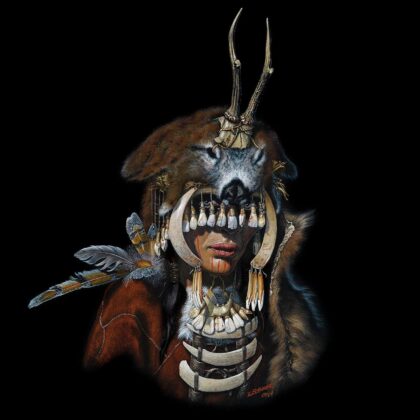
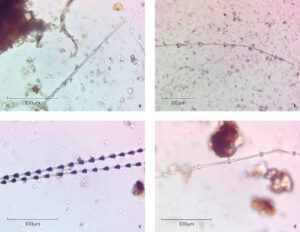
Perhaps among the most astonishing findings is the presence of microscopic feather fragments. While feathers would have decayed in soil, tiny structures known as barbules, measuring under a millimeter, might have been preserved under the right conditions. Analysis conducted on samples around the woman’s head confirmed goose feathers. This provided the first direct evidence that her headdress likely included an elaborate feather adornment. It aligns with earlier artistic reconstructions based on ethnographic comparisons, suggesting a feather-adorned headdress.
Feathers appeared in an unexpected area as well. During the recent excavations, researchers found that there was a separate pit directly in front of the burial that had been created approximately 600 years after the woman’s interment. It contained two masks made from deer antlers. Analysis revealed traces of songbird and grouse feathers, as well as remains of bast fibers, suggesting that these deer antlers were once part of a complex costume-like headgear. All of this clearly pointed to the fact that the shaman’s grave continued to serve as a ritual focal point long after her demise, with later groups leaving offerings that honored her enduring significance.
These findings contribute to an ever-expanding understanding of the woman as a highly respected ritual specialist within her society, whose spiritual role might have reverberated down through the generations. During the past several years, researchers have compiled a wealth of new data from the grave, making it perhaps the most intensively researched Mesolithic burial in Central Europe.