









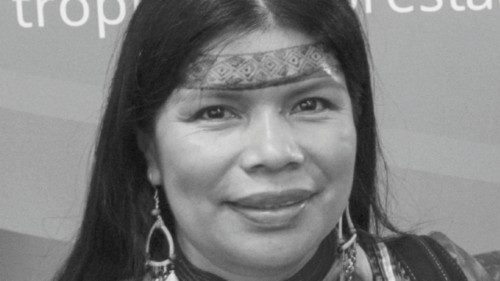
“Communities are not immune to sexism. On the contrary…”. This observation, delivered with her usual verve, has not discouraged Patricia Gualinga, one of the most recognized voices of resistance in the Amazon. In the early 2000s, the advance of oil concessions in Ecuador and on the territory of her people – the Sarayaku – thrust her into the frontline. Not yet thirty and serving as director of the regional Tourism office, Patricia Gualinga left her job and city to join the nonviolent struggle that, in 2012, led the Inter-American Court of Human Rights to condemn Quito, forcing the State to reverse its decision.
Upright as a native princess, proud gaze, long black hair, thirteen years later, she continues to fight for “Kausay Saya”, the living forest and all its creatures. She does so as vice-president of the Ecclesial Conference of the Amazon (CEAMA) and as permanent representative to the United Nations Forum on Indigenous Issues. For her commitment, she has faced attacks and threats, which force her to “take a few extra precautions”, she downplays. “We Gualinga are a family of fighters”, she smiles. Her parents were long-time activists, as are her sister Noemi and her nieces Helena and Nina. Patricia, above all, had a special bond with her father, Sabino, shaman and first catechist and minister of the Word among the Sarayaku. “He was a teacher of life and faith. He showed me that there is no conflict between indigenous tradition and the Gospel. There is a God, Father and Creator, as Jesus teaches us. We cannot see Him, but He is present in all things, starting with nature. Nature itself is not a deity, nor are the rivers, the land, or the trees. My father, as a shaman, through dreams and visions, could communicate with the forest and ease the suffering of the sick, both body and spirit. But he never confused the two: God – he knew and told us – transcends all and everyone”.
A woman and an indigenous person. She had to face a double prejudice to become a respected leader both within and outside her community. It must not have been easy.
Indeed, no, it was very complicated to be heard. As I said, even among indigenous peoples there is strong distrust toward female leadership. Women are weighed on a scale calibrated for perfection. Men are not. And they ask us to be and give our best, forgiving not the slightest imperfection. Personally, it helped that I come from an “unusual” family: generations and generations of activists. I have always had the support of my parents, and that was decisive.
Is femininity, in your view, somehow associated with nature?
Women have a special sensitivity in “feeling” the other in general. This makes us more open, more receptive spiritually. And it helps us to connect more easily with nature.
What does it mean, and how is it possible “to connect” with nature?
As indigenous people, we have “channels”, small “doors” that help us to glimpse the forest and its creatures. But I cannot guarantee that they work for Westerners (laughs). The main medium is dreams. By interpreting them, we can understand what nature wants to tell us. For example, if we dream of a newborn, we know it is how the yucca, the Sarayaku’s main food, communicates with us. If the baby says “mama” it is a sign that the harvest is growing well. If it cries and is sad, there is some problem with the soil or the sowing. The waters of the rivers generally appear in dreams as adults and can indicate where it is safe to fish or where it is better not to, due to pollution. It is not all clear-cut or mathematical, of course. Dreams must be analyzed and understood. Shamans learn to do this through a life of study, discipline, and sacrifice – for instance, they cannot marry until fully trained, which can take years – to “sharpen” the senses to perceive what nature barely whispers. And they help others do the same. I mean real shamans.
I imagine you mean the so-called tourist shamans who perform rituals, especially with the hallucinogenic herb ayahuasca, on demand for foreign travelers seeking “spiritual experiences”. How do you recognize a real shaman?
Yes, “ayahuasca tourism” is sad. And pointless: it will hardly fill the empty space we think we can fill. Not to mention dangerous if the ritual is led by someone who is not properly trained. A true shaman can be recognised by their eyes, as every indigenous person knows. Their gaze is deep because they see beyond. Often, they don’t even need to introduce themselves as a shaman. You can tell by the way they look at you.
Your people believe that we are all connected by invisible threads. What does that mean?
Ecosystems are connected to each other by filaments that the common eye cannot see. Through these imperceptible channels flows the spiritual energy that continuously regenerates them and keeps everything in balance. We have always said this and no one listened. Now, however, even science is beginning to study the connections between plants, waters, and environments.
What happens when a thread breaks?
Life dies because the regenerative force struggles to pass through. Imbalances begin: the Amazon risks turning into a savanna, mountains erode, rivers dry up. The threads that connect us are like a spider’s web: break one, and the entire design collapses. Unless the spider weaves it again. But that takes time, lots of time. And the planet does not have it.
The next UN Climate Change Conference (COP30) will open on November 10 in Belém, in the Amazon. As an indigenous person, what do you expect from this summit?
I hope that the Amazon will finally be recognized as a legal entity. This is the dream that I and many delegates of the native peoples will bring to the summit, where we are determined to make an impact.
What does “Kawak Sacha”, living forest, mean?
It is not a model created by default. It is a proposal for protecting the common home that the Sarayaku people have developed over their ancestral history. We ask that some crucial areas, starting with the Amazon, be recognized as legal entities and, as such, not exploited by the market, nationally or internationally. Their protection and conservation should also be entrusted to those who have always safeguarded them: the indigenous peoples.
Do you think Western societies are ready to listen to your proposal?
They have never been ready. Now, however, the moment is critical. There is no “Planet B”. Faced with the imminent catastrophe, indigenous peoples once again propose what is most sacred in their culture: the interconnection among all living beings. If the rest of the world stubbornly refuses to listen, disaster will follow. Westerners must begin to open their minds, imprisoned by excessive rationality, to understand that they are part of nature, and destroying it means destroying themselves.
When you say these things at the United Nations, do they listen?
Well, as part of the Permanent Forum on Indigenous Issues, they are forced to. In any case, I have been given an important opportunity to bring the voice not only of the Sarayaku but of all indigenous peoples of Latin America to the global stage.
And the Catholic Church? During the Amazon Synod, in which you participated, you invited the ChatolicChurch to listen. Is she doing so?
I think so. I am vice-president of the Ecclesial Conference of the Amazon (CEAMA), which is one of the fruits of the Synod. During the Assembly, we discussed the importance for the Church to divest from those economic structures that destroy the environment. And she is doing so. The process is ongoing – not as fast as we would like, but it is progressing. I believe everything happens in its due time. That is the Creator’s time, not ours.
You, like your parents, are Catholic. And like them, you combine indigenous culture and spirituality with faith in Christ.
I repeat, there is no conflict. Indigenous spirituality concerns what is within nature. Catholic spirituality looks to the transcendent. The union of these two “universes” helps us grow, both as indigenous people and as Catholics. As indigenous people, because we feel the common home even more sacred as a gift from the Father. And as Catholics, because we commit to protecting the Creation God entrusted to us.
Your commitment to the Amazon has brought criticism, misunderstandings, even death threats. Has faith helped you in difficult times?
Faith helps me every day. In difficult moments, I pray to the Spirit to fill me with peace and courage. To find it, I immerse myself in nature, full of its vital force.
If you were to advise a Western woman concerned about the state of the planet, where should she start to become an agent of change?
First, try to see nature from a different angle. We have been taught that everything is market, but it is not true. Money is necessary to live. However, there are things that cannot be bought or sold. The common home is one of them. To truly “feel” it, not just understand it rationally, we must reconnect with the trees, the waters, the animals, the sky. I do not suggest a mass relocation to remote wilderness areas, nor Amazon tours for ayahuasca. Each person should do it where they live. Even in big cities, there are parks and gardens. Go there slowly. Stop to observe, listen, breathe. Pay attention to dreams, which are windows into our inner world. Rediscovering nature will benefit physical and spiritual health. A change of perspective, renewing your gaze, is essential to create major transformations in families, local communities, and national and international administrations.