






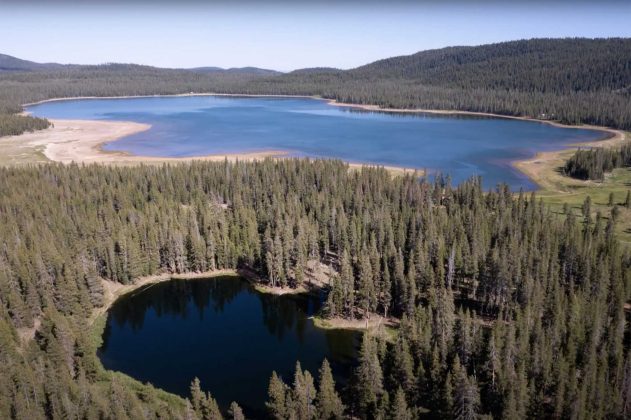
MCCLOUD, Siskiyou County — Medicine Lake is a destination for people who want to get away from people.
Nestled in the crater of an ancient volcano some 350 miles north of San Francisco, the lake’s pristine waters, forested shoreline and distinct lava formations had not one visitor on a late fall afternoon, even before heavy snow blocked the long road in. Other days, a few boaters and campers may scamper about. Native Americans often come for worship.
“Our people have been severed from these places, but these places haven’t lost their power,” said Monica Super, a member of the Pit River Tribe and Modoc descendant, who had recently come to Medicine Lake to recharge in the peace and quiet. “The relationship I’ve built with this place is similar to (my relationship with) my great aunt: I would go to her home broken and would leave full.”
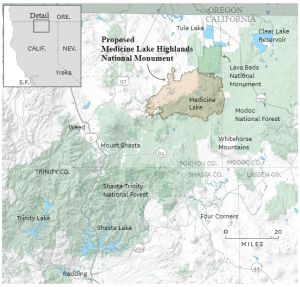
The cherished lake is now at the center of a campaign to make this geologically unique and spiritually significant area, known as the Medicine Lake Highlands, or Sáttítla in the parlance of the Indigenous community, California’s next national monument. The designation would ensure greater protections for the property northeast of Mount Shasta and raise its profile among America’s public lands. The remote highlands are managed by the U.S. Forest Service.
The push for the roughly 200,000-acre monument in Siskiyou County and a sliver of Modoc County is being led by Northern California’s Pit River Tribe. The effort has, so far, won support from a handful of conservation groups and, recently, the Newsom administration. The White House, which holds the authority to make the monument designation, has not spoken publicly about the proposal.
The campaign joins at least three other petitions for monument status in California. A 660,000-acre Chuckwalla National Monument is being proposed in the Southern California desert, as are expansions of two existing monuments — Berryessa Snow Mountain between Napa and Mendocino counties, and the San Gabriel Mountains north of Los Angeles.
At Medicine Lake, under a cloudy midday sky that obscured the surrounding mountains, evidence of the region’s fiery past unfolded in every direction.
Hardened flows of lava spanned nearby for miles across treeless hillsides, displaying striking outcroppings of obsidian, rhyolite and other volcanic rock. Pumice fields here were used by NASA astronauts to train for moon landings.
Several cave openings dotted the unusual terrain, exposing lava tubes bored by volcanic vents and flowing molten rock in a maze of underground pathways. Caving is popular among those who visit.
The underlying Medicine Lake volcano, whose history of lava flows and gas expulsions chiseled the landscape, is likely the largest volcano, by volume, in the Cascade Range, which includes such giants as Mount Saint Helens and Mount Rainier, according to the U.S. Geological Survey. The mountain’s most recent eruption was about 950 years ago.
The human history here is tied to the area’s otherworldliness. Native Americans across Northern California, including the Pit River, Modoc, Shasta, Karuk and Wintu peoples, have long come for prayer and ritual, often attributing supernatural powers to the area.
“It’s the first place that I ever had a divine cultural intervention,” said tribal member Super. “It happened there on the banks of the lake during ceremony.”
Courtesy of Bob Wick
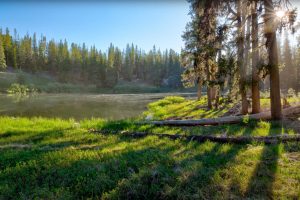
One of the continuing traditions of Super’s Pit River Tribe is an ancestral run between Mount Shasta and Mount Lassen, through the highlands. The participants sometimes stop to soak in the reputed healing waters of Medicine Lake, at 6,770 feet elevation, or its adjacent sibling Little Medicine Lake.
The primary motivation for the monument drive is to cement the end of a decades-old fight to prevent geothermal energy development here. While the Pit River Tribe has succeeded, through litigation, at keeping the federal government from extending leases for energy exploration and potential power production, the possibility exists, however unlikely, of the leases being reactivated.
Geothermal drilling, critics say, would not only scar the landscape but threaten water quality in aquifers that feed the Fall and Pit rivers, and eventually Shasta Lake, the largest reservoir in California.
The designation of a national monument would restrict industrial activities.
“We can’t be wasting our lives and our children’s lives battling projects that aren’t congruent with the area,” said Brandy McDaniels, cultural representative for the Pit River Tribe’s Madesi Band and the tribe’s lead on the monument campaign. “We need to find these protections and solutions and put them in place.”
Whether a national monument is established hinges on a number of factors, among the foremost being support from local communities and their political representatives.
A handful of officeholders contacted by the Chronicle, from both political parties, said they were still reviewing the proposal, including Sen. Alex Padilla. Calpine, the Houston-based company that had sought to harness energy in the highlands, did not respond to a request for comment. There is no known organized opposition effort.
“We very much want to protect these sacred lands,” said Michelle Berditschevsky, founder of the Mount Shasta Bioregional Ecology Center and senior conservation consultant for the organization. The center has long allied with the Pit River Tribe and Stanford University’s Environmental Law Clinic to fight off development in the area.
While the Biden administration has remained mum on the Medicine Lake campaign, the president is on pace to to use his authority, under the Antiquities Act, to protect more acreage through monument designations than most of his predecessors. He has, so far, established five new national monuments and restored two that lost their status during the Trump administration. None of the land, though, has been in California.
Historically, the bulk of monument designations have come in the final year of a president’s four-year term, which is approaching for Biden. Lobbying for the highlands is likely to pick up.
“I’m so excited to bring this proposal to Washington D.C. and ultimately ask our president to designate the Medicine Lake Highlands a national monument,” Wade Crowfoot, the secretary of the California Natural Resources Agency, said in a statement. “Now is the time to take action to preserve this irreplaceable landscape for future generations.”