











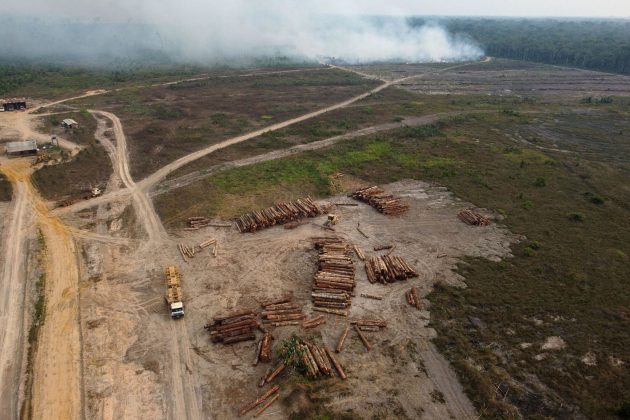
The annual survey by the World Resources Institute, a research organization, found that the world lost 10.2 million acres of primary rainforest in 2022, a 10 percent increase from the year before. It is the first assessment to cover a full year since November 2021, when 145 countries pledged at a global climate summit in Glasgow to halt forest loss by the end of this decade.
“We had hoped by now to see a signal in the data that we were turning the corner on forest loss,” Frances Seymour, a senior fellow at the institute’s forest program, said. “We don’t see that signal yet, and in fact we’re headed in the wrong direction.”
The report, done in collaboration with the University of Maryland, documented tree loss in the tropics from deforestation, fires and other causes. Last year’s destruction resulted in 2.7 gigatons of carbon dioxide emissions, a significant amount that is roughly equivalent to the annual fossil fuel emissions of India, a country of 1.4 billion.
Tropical deforestation also degrades some of the planet’s richest ecosystems, the habitats for plants and animals and the regulators of rain patterns for several countries.
The Amazon rainforest, the largest in the world, hasn’t faced such enormous destruction in almost two decades, according to an analysis of the World Resources Institute data by Amazon Conservation, a research organization.
Latest News on Climate Change and the Environment
Worms in the Arctic. As human-caused climate change raises temperatures and thaws the permafrost, worms are taking over territory in the Far North that’s been wormless since the last ice age. Scientists say the expansion will inevitably change northern ecosystems, with implications for the whole planet, in ways we don’t fully understand and probably can’t undo.
Natural gas leaks. Natural gas, long seen as a cleaner alternative to coal and an important tool in the fight to slow global warming, can be just as harmful to the climate, a new study has concluded, unless companies can all but eliminate the leaks that plague its use.
A law to repair nature. After an unexpectedly bitter political battle, European lawmakers approved a bill that would require E.U. countries to restore 20% of nature areas within their borders on land and at sea. The measure, a key element of the bloc’s Green Deal environmental initiative, passed with 336 votes in favor, 300 against and 13 abstentions.
Underground heat in Chicago. Since the mid-20th century, the ground between Chicago’s city surface and the bedrock has warmed by 5.6 degrees Fahrenheit on average, according to a study out of Northwestern University. The heat has caused the earth to deform over the decades, potentially worsening cracks in building foundations.
Heat waves. More than 61,000 people died because of brutal summer heat waves across Europe in 2022, according to a study published in the journal Nature Medicine. The findings suggest that two decades of efforts on the continent to adapt to a hotter world have failed to keep up with the pace of global warming.
Heat records. As an astonishing surge of heat across the globe shattered temperature records from North America to Antarctica, forecasters warned that the Earth could be entering a multiyear period of exceptional warmth driven by continued emissions of heat-trapping gases and the return of El Niño, a cyclical weather pattern.
Brazil, the country with the largest portion of tropical rainforest, had the highest rates of deforestation globally. It accounted for more than 40 percent of tree loss globally, followed by the Democratic Republic of Congo and Bolivia.
Bolivia delivered some of the report’s most striking numbers. Forest loss there went up 32 percent last year, the highest rate on record for that country. It was one of the few tropical forest countries that did not sign the Glasgow commitment on deforestation.
Marlene Quintanilla, a research director at the Fundación Amigos de la Naturaleza, a nonprofit group in Bolivia, said a powerful driver of destruction in that country has been a government policy that encourages farmers to clear vast tracts to secure land titles.